
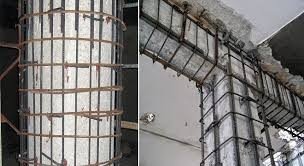
Structural jacketing services for columns and beams to improve load-bearing strength and durability.
-
- Primary Applications
-
- 1) Seismic Retrofitting: Enhancing A Building’s Ability To Resist Earthquake Forces By Improving The Ductility And Energy Dissipation Of Its Core Members.
-
- 2) Correcting Design Or Construction Defects: Repairing Structures That Were Built With Inadequate Reinforcement, Design Errors, Or Poor-Quality Concrete.
-
- 3) Upgrading Load Capacity: Necessary When Adding New Floors To An Existing Building Or Changing Its Use (E.G., Converting A Residential Building To A Heavy Industrial Warehouse).
-
- 4) Repairing Deterioration: Restoring Members Weakened By Environmental Factors Like Corrosion Of Original Rebar, Fire Damage, Or Chemical Attacks.
-
- Types Of Jacketing
-
- 1. Reinforced Concrete (RC) Jacketing: The Most Common Method, Involving A New Cage Of Steel Rebar And A Layer Of Concrete (Often Micro-Concrete Or Shotcrete) Poured Around The Existing Member.
-
- 2. Steel Jacketing: Steel Plates Or Sections Are Wrapped Around The Column And The Gap Is Filled With Non-Shrink Grout. This Provides High Confinement With Minimal Increase In Member Size.
- 3. Fiber-Reinforced Polymer (FRP) Wrapping: High-Strength Carbon Or Glass Fiber Sheets Are Bonded To The Surface Using Epoxy. It Is Lightweight, Corrosion-Resistant, And Adds Virtually No Weight Or Volume.
1. Surface Preparation: The Existing Concrete Is Chipped Or Sandblasted To Expose A Rough Surface For Better Bonding.
2. Anchorage: Steel Dowels Are Drilled Into The Existing Member To Ensure The New Jacket Acts Monolithically With The Old Core.
3. Reinforcement: New Longitudinal Bars And Transverse Ties (Stirrups) Are Installed Around The Member.
4. Casting/Wrapping: For RC Jacketing, Formwork Is Placed And Concrete Is Poured. For FRP, The Sheets Are Wrapped And Saturated With Resin.
5. Curing: Proper Curing Is Essential For The New Jacket To Reach Its Design Strength.